
Now is the time to tell your T&S story (updated framework)
I'm Ben Whitelaw and this is Trust & Safety Insider. I'm stepping in for Alice to return to a topic that I've covered before, that is riding high in the news agenda and that is unlikely to go away any time soon.
I'm working on several exciting things that aren't quite newsletter-ready. But reach out if you have views about today's topic and where we go from here. Here we go! — Ben

OSX Network is the professional home for people working in online safety.
Become a verified member of our global community to access certification, sector news and opinion, research, resources, and tools.
It's you or the 27-year-old Brit
It's been two months since TrustCon 2026, although it doesn't feel more than about ten minutes ago. For a lot of you, the gap between then and now hasn't been restful.
The layoffs that have hollowed out T&S teams at the bigger platforms over the past couple of years have affected small and mid-sized ones too. I know some of you reading this are doing more with less, or wondering how much longer your role exists at all. If that's you, I see it, and I'm sorry it's the backdrop to this piece.
None of that reflects the value of the work itself. A team getting smaller doesn't mean the judgment, the policy knowledge, and the years of pattern-recognition have got any less necessary. If anything, the opposite is true.
The past seven days are evidence of that: the dire prognosis offered by a 27-year old Brit has led frontier labs to call for AI development to be paced — because calling it a slowdown is seemingly an admission of defeat — and politicians to wade into the debate about how AI should be regulated, without so much as a life jacket.
These conversations, and this moment, are the exact time the general public need the exact expertise T&S professionals have spent years building. Most of the time, however, it's nowhere to be found.
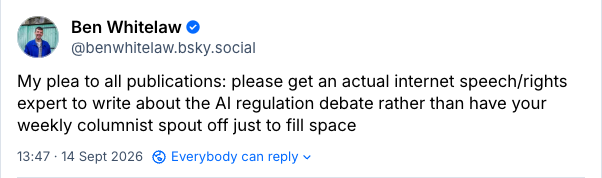
All that is to say: if you were thinking about telling your T&S story, now is a pretty good time to do it.
Updating my priors
Regular readers will know I've written before about the comms tangle that T&S workers sit within. The framework I came up with back in July sought to capture the tensions between the three groups that all have a stake in this story but whose priorities and incentives rarely align:
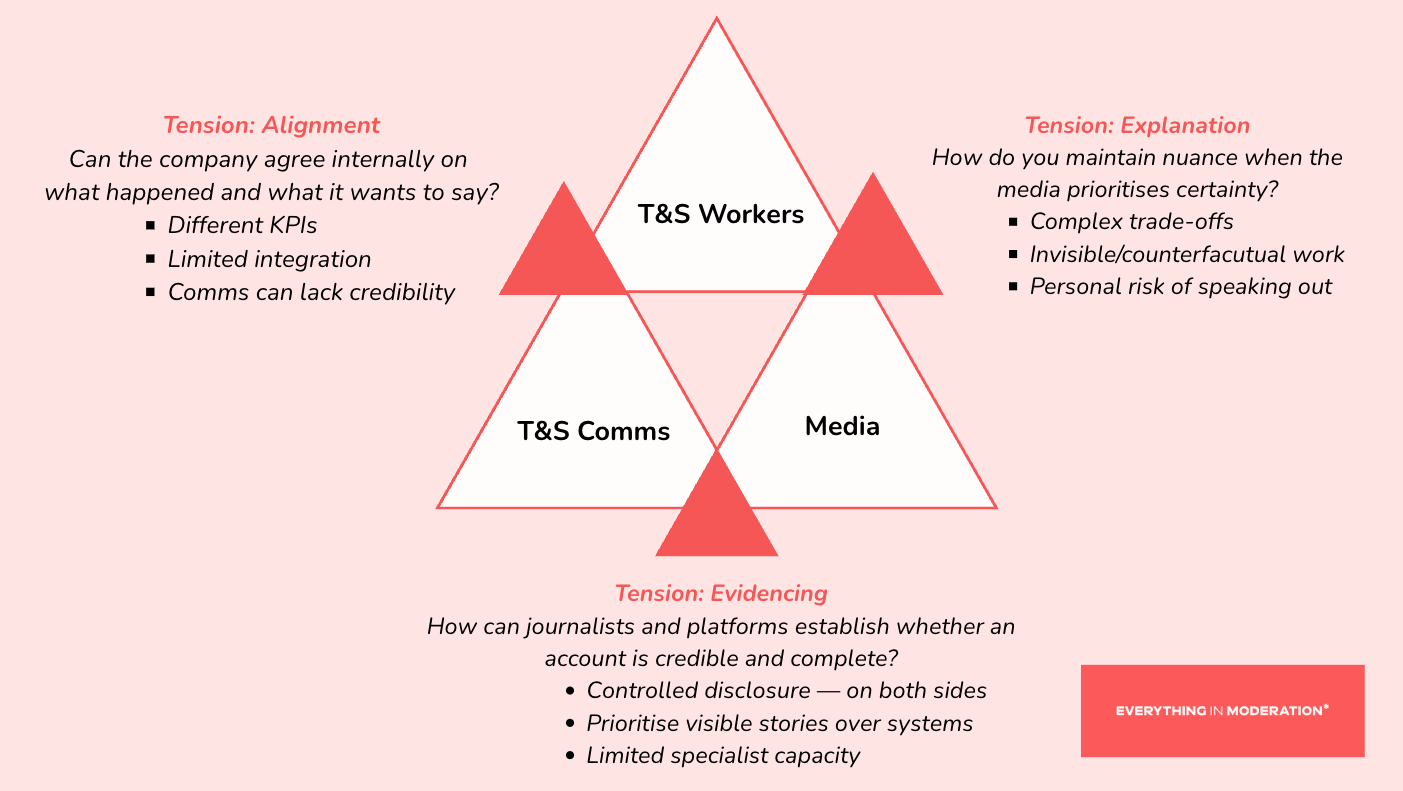
I got the chance to take those arguments out for a walk when I appeared on Thorn's Safe Space podcast with Yoel Roth (Match Group) and Vaishnavi J (Vice) back in July.
The conversation has just been published in audio and video form, but here's the gist of what I said on it:
- Opacity is a valid route for T&S functions to take, but not one to lean on indefinitely. I pointed to journalism's retreat behind institutional distance, which has left it with the reputation of wielding "power that's not always been best used," and eroding the trust it was meant to protect.
- How much a company says publicly about safety, or doesn't, is a strategic choice rather than an unavoidable constraint. And, as I also said, within the limits of law and security, "it's a call that you can change."
- Traditional media defaults to people and stories and are "not really interested in systems." This doesn't always yield nuanced, thoughtful coverage of the industry and, while independent, nuanced coverage is starting to fill that gap, it's still rare and hard to sustain.
What Yoel and Vaishnavi changed
After the conversation with Yoel and Vaishnavi, I realised the framework needed updating to reflect two of their points: