
7 min read

Why telling the T&S story is harder than it seems

Trust & Safety’s difficulty explaining itself reflects deeper tensions between the people doing the work, comms teams tasked with protecting company reputation and the journalists trying to hold platforms to account.

I'm Ben Whitelaw, the founder and editor of Everything in Moderation*. I've commandeered the Trust & Safety Insider mic to talk about a topic that has been top of mind for many T&S professionals lately. Alice will be back next week in her usual slot.

Both Alice and I are in San Francisco this week for TrustCon, a gathering of many of the great and good of Trust & Safety. As well as recording an episode of Ctrl-Alt-Speech — in your podcast feeds on Thursday — I'm taking the chance to speak to attendees about how they are feeling about the industry at a time when so much is happening. If you're here and want to say hi, drop me a line.

Get in touch with your thoughts — good, bad and ugly — about today's topic. Here we go! — Ben


in partnership with Safer by Thorn, a purpose-built CSAM and CSE solution
CTA Image

New feature! Context Labels add more information to suspected CSAM.

As part of Thorn’s continued commitment to helping trust and safety teams detect and disrupt child sexual abuse material (CSAM), we're happy to announce that Safer now includes Context Labels, a new feature that provides additional signals for suspected CSAM.

These new Context Labels give trust and safety teams greater clarity when reviewing suspected CSAM by providing three predictive signals for nudity, apparent maturity, and sexual content. This gives your team more context during moderation, so you can:

  • Triage content more efficiently
  • Prioritize high-risk cases
  • Make more informed moderation decisions

These labels can integrate into your existing moderation workflows to help your team filter, sort, and prioritize flagged content, whether you're using Safer directly or incorporating results into your own internal review tools.

LEARN MORE

Speaking out is a systems issue

Why this matters: The T&S industry still lacks a shared understanding of why it struggles to explain and advocate for its work. Practitioners, communications teams and journalists all shape that story; this framework offers a starting point for identifying where it breaks down and how to improve it.

There has been one particular T&S conversation that has been rumbling in the background for the last 12 months: to what extent should T&S professionals be telling the story of Trust & Safety, and, if so, how?

The germ of the debate was Casey Newton’s widely discussed Platformer essay last year, “Is anyone left to defend trust and safety?”. In it, he argued that more safety workers should speak to reporters, write op-eds and even quit their jobs in response to the dismantling of T&S functions and the layoffs of thousands of internet workers. Unsurprisingly, his argument wasn’t particularly well received and I’ve spoken to many people who felt it was an unfair expectation.

The topic reared its head again at the T&S Summit in London earlier this year, where several sessions I attended debated whether practitioners had a responsibility to explain their work more publicly in order to earn the trust of users, regulators and civil society. Some argued that the profession had become too invisible to defend either its record or its continued importance. Others questioned whether public visibility was desirable — or even compatible with work that often depends on discretion, confidentiality and protecting staff from abuse.

Anyone working in Trust & Safety — or following it from the sidelines — cannot have failed to notice that the field is under considerable pressure right now. Shrinking teams, increasing political scrutiny, growing regulatory obligations and AI upending decades of established safety norms has created uncertainty about what the profession is for and who sticks up for it.

Yet the recurring debate over who should be responsible for explaining its work and impact suggests the industry lacks a shared view of what the answer is, or indeed how it should be done. I expect the question to surface at TrustCon this week, as thousands of T&S professionals gather to discuss the future of the field.
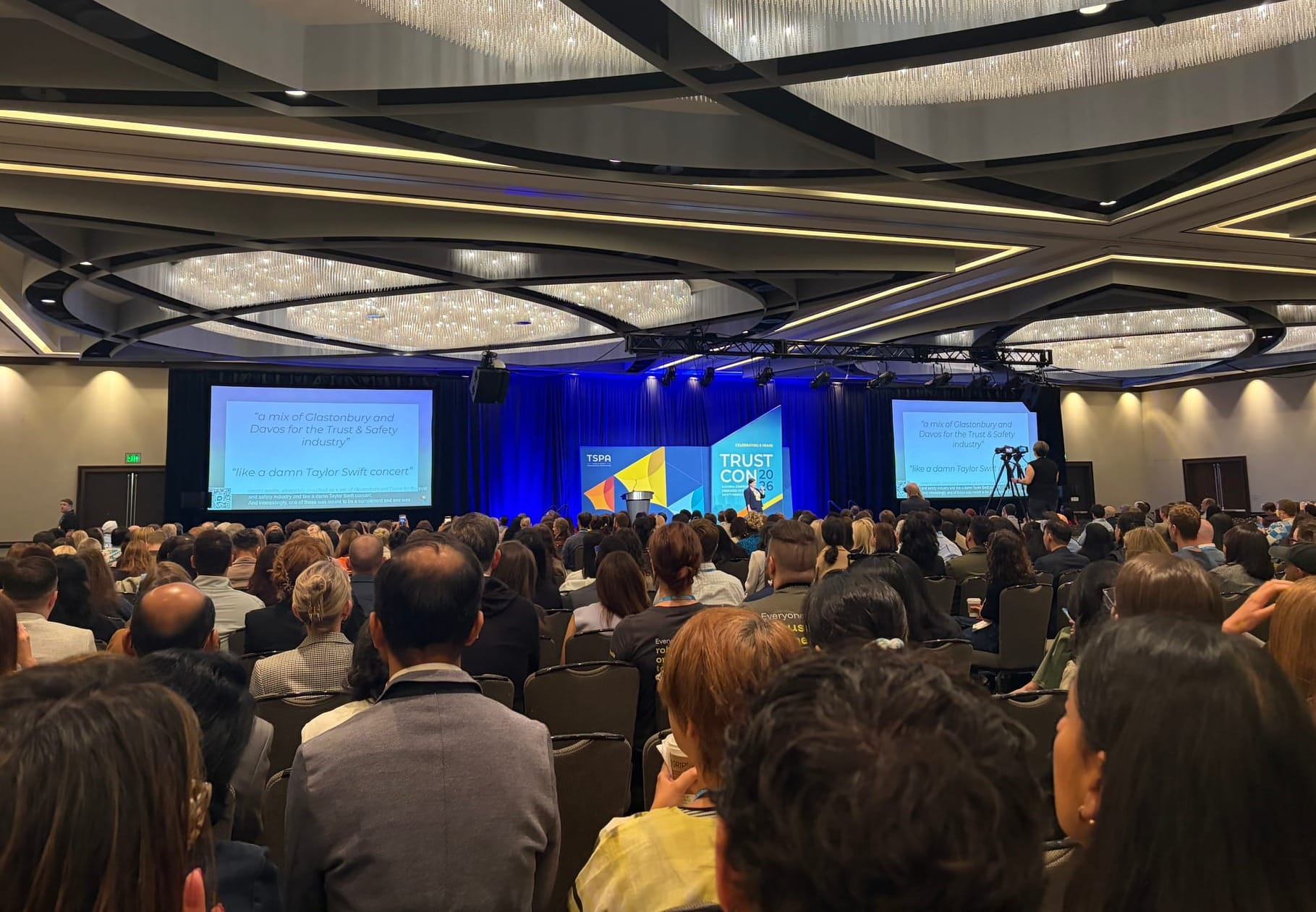
A woman standing up at TrustCon giving a presentation in front of a crowd
TrustCon is taking place in San Francisco this week

Friction in the system

Over the past few months, I've spoken to people that sit within three groups that have some responsibility for telling that story: 

  1. T&S professionals who have previously spoken out, expressed a desire to do so, or have some level of public presence; 
  2. T&S comms professionals tasked with explaining the safety decisions that platforms make, and
  3. Journalists and other media professionals who report on, and try to make sense of, platform decisions.

The issue, I found, is not that T&S workers don’t want to speak out. Rather, each is part of a system that makes telling a complete, credible story surprisingly difficult.

The working framework below is my attempt to explain why, based on those informal conversations.

A framework for understanding why T&S struggles to tell its story with three triangles labelled T&S workers, T&S comms and media

NB: Naturally, there are other ways in which the narrative of T&S can be told. At the London summit earlier this year, Yoel Roth, VP of T&S at Match Group, provided a laundry list, including writing blog posts, developing a presence on LinkedIn, speaking at conferences, teaching and even advocating internally at the company you work for.

Talking to the press is the form of external communication best understood by companies, the one they have been doing the longest and, arguably, the quickest way to influence wider public opinion. So that’s where I’ve focused my attention.


From the informal conversations I had, it’s very clear that there is friction that prevents the three groups from working with each other to tell the story of T&S. I’ll go through the tensions one by one.

The first friction sits between T&S workers and communications teams. I've called it ‘alignment’. Both may want users and stakeholders to trust the product, but they are often accountable for different outcomes. Practitioners are generally focused on identifying and reducing harm; communications teams are responsible for how the company and its decisions are understood. One is principally concerned with operational effectiveness, the other with reputational consequences.

The relationship is made more complex by the fact that the teams often report into different parts of the business, become involved at different stages of the decision-making process (with comms often much later than they’d like) and rarely have incentives that fully align. The result is that complex operational decisions that make users safer become difficult to explain in a way that the public can readily understand.

The second friction sits between T&S workers and the media. I have dubbed this “explanation” for want of a better phrase. Much of Trust & Safety's best work is invisible: the abuse campaign that never reached users, the coordinated network removed before it spread or the product risk mitigated before launch. That doesn’t always chime with journalists, who tend to report on what they can see or what researchers have found on platforms; that’s why there is a unique genre of story about dummy or test accounts that are served harm “within [insert timeframe]”. 

Meanwhile, T&S practitioners often can't easily disclose the work they are doing or, as Casey might have it, the harm that was perpetuated as a result of company decison-making, for a myriad of reasons. The professional risk and possibility of losing their jobs would be enough for most people, but practitioners also worry that important trade-offs and nuance will be flattened into a binary story of success and/or failure. If you’re asking me, that concern is justified — stories in traditional outlets don’t often allow space for uncertainty or an explanation of systemic issues, in part because there’s a feeling that audiences don’t want that.

The final friction is between T&S comms teams and the media, which I've labelled “evidencing”. The thing I heard loud and clear here is that neither side ever has the complete picture. Platforms share carefully managed statements and selective data while journalists protect sources, withhold evidence and often refuse to share screenshots or other evidence of harm with T&S teams for fear of being scooped. 

At the same time, the shrinking number of specialist reporters who understand platform governance means that a) there are fewer outlets and journalists to pitch to, and b) the time taken to package up a complex story about a positive safety intervention and brief a reporter is often considered not worthwhile. The result is a kind of “selection effect” in which the stories that do get published often revolve around harmful incidents on platforms rather than the systems that we all know contribute to them.

No one to blame, everyone responsible

It’s important to say that these three tensions cannot be reduced to the failure of any single group. But neither are they entirely accidental or blameless. Platforms choose how much evidence to collect and disclose, which staff may speak and whether communications teams are involved before decisions become crises. News organisations choose how much specialist expertise to retain and how to frame uncertainty. Practitioners make difficult judgements about when professional discretion becomes institutional silence. The constraints are structural, but the structures are still the product of decisions.

Nonetheless, these three relationships help explain why Trust & Safety so often struggles to give a credible public account of itself.

I hope laying them out in this way goes some way towards doing two things: 

  1. Building a shared understanding as why Trust & Safety so often struggles to tell its own story — and why simply asking practitioners to "speak up" is unlikely to solve the problem on its own. 
  2. Identifying the interventions that could ease the friction between these three groups. I outlined some thoughts in my chapter for the recently published Trust, Safety, and the Internet We Share: Multistakeholder Insights and will save the rest for another newsletter.

Not everyone will agree with what I’ve shared here or what the interventions look like. But if those ideas are going to take shape anywhere, I can see it happening at TrustCon this week.

You ask, I answer

Send me your questions — or things you need help to think through — and I'll answer them in an upcoming edition of T&S Insider, only with Everything in Moderation*

Get in touch

Also worth reading

x headline hyperlinked so that it's red x (Source in italics)
Why? 1-2 lines justification for reading here

x headline hyperlinked so that it's red x (Source in italics)
Why? 1-2 lines justification for reading here

x headline hyperlinked so that it's red x (Source in italics)
Why? 1-2 lines justification for reading here

x headline hyperlinked so that it's red x (Source in italics)
Why? 1-2 lines justification for reading here